Publications

Selected papers are highlighted

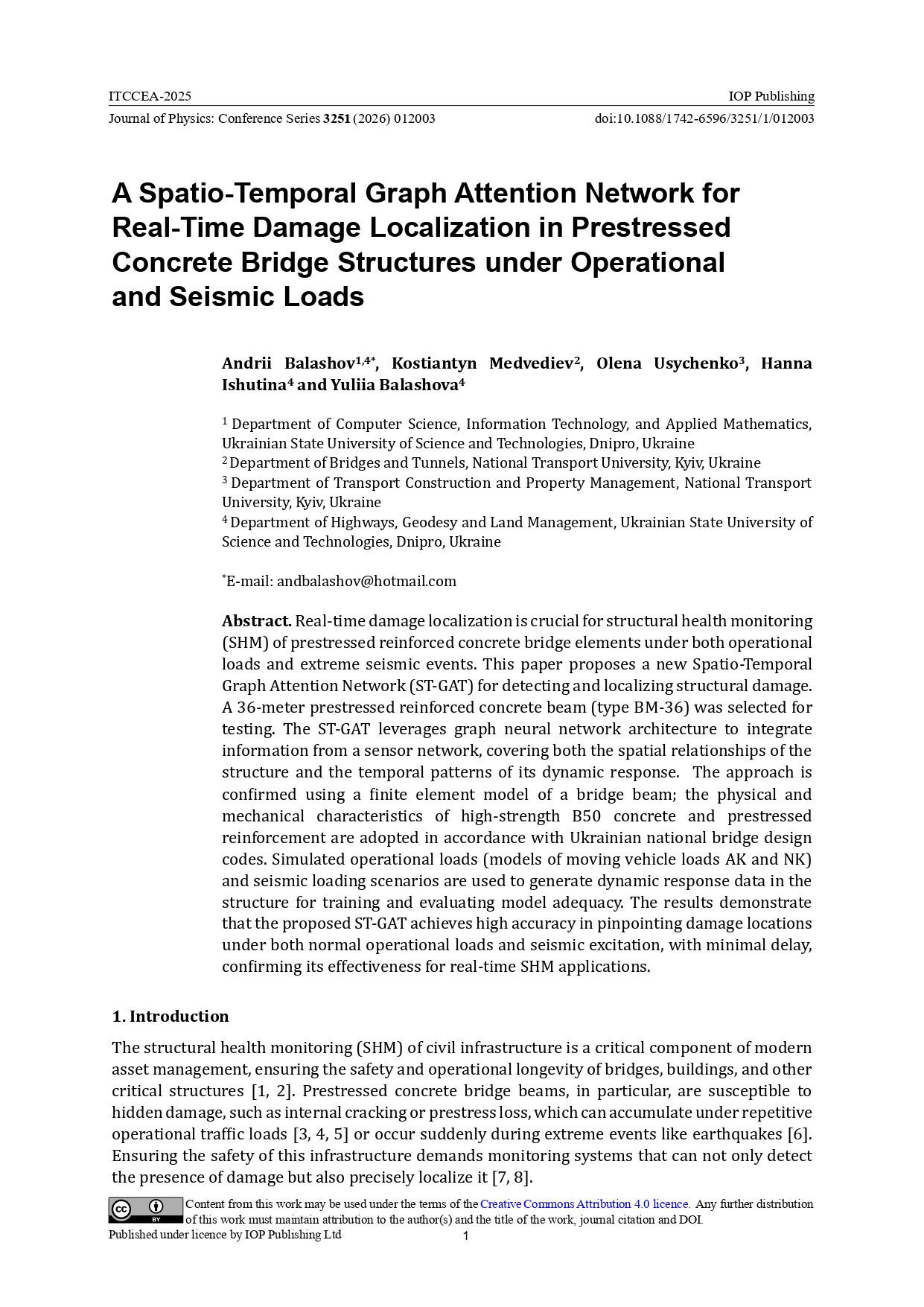
Illustration for Adaptive Traffic Signal Optimization with Thermal Sensors and Reinforcement Learning

Adaptive Traffic Signal Optimization with Thermal Sensors and Reinforcement Learning

Andrii Balashov, Olena Ponomarova, Yuliia Balashova, Olexandr Tregub

Results in Engineering, 2025

  • Proposes an adaptive traffic light controller using FLIR TrafiOne thermal sensors and reinforcement learning.
  • Frames intersection control as a Markov Decision Process over real-time sensor data.
  • Reports up to 38% reduction in average delay compared to fixed-time signal plans, with headroom for multi-intersection coordination.
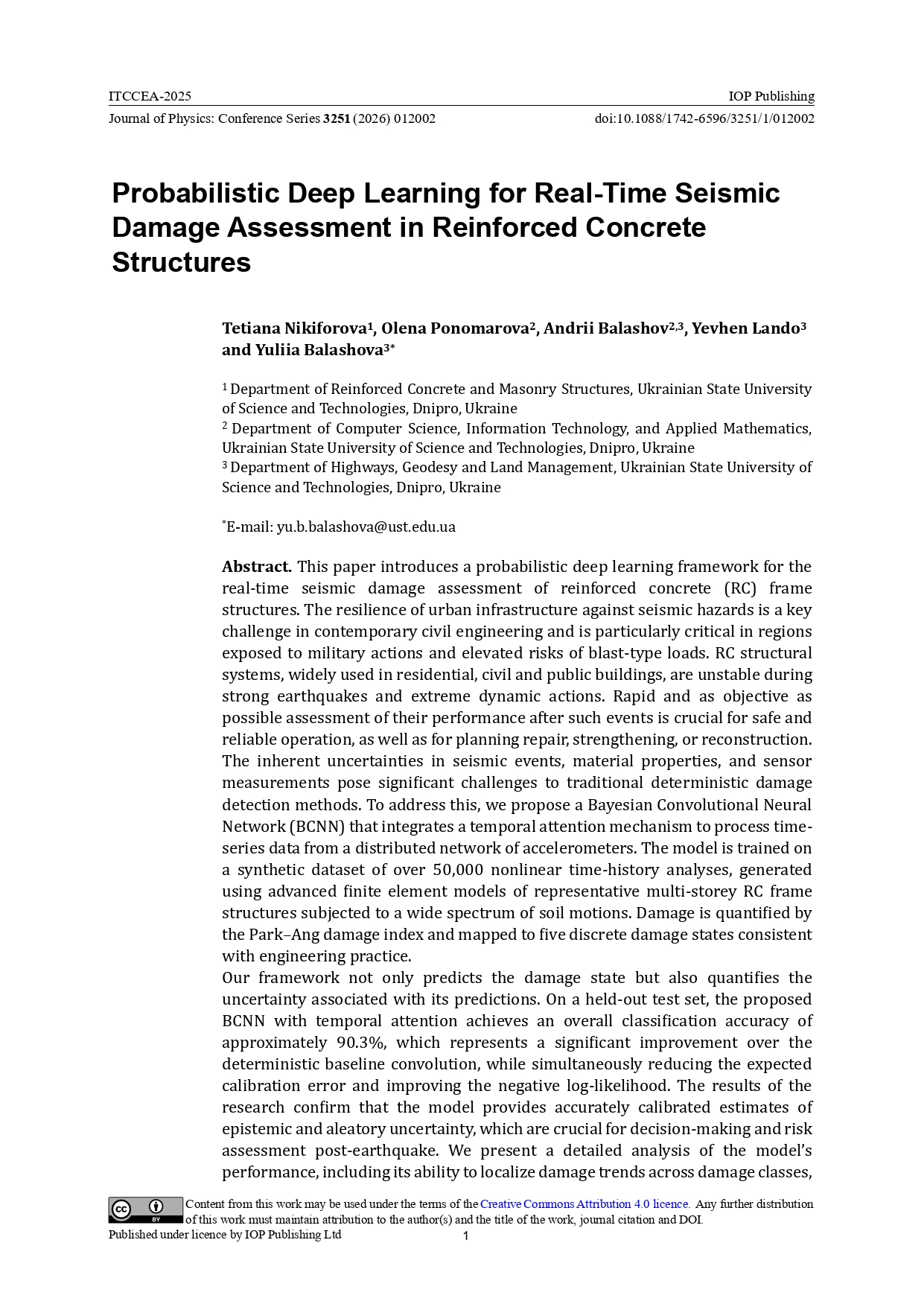
Illustration for Reinforcement Learning Fine-Tunes a Sparse Subnetwork in Large Language Models

Reinforcement Learning Fine-Tunes a Sparse Subnetwork in Large Language Models

Andrii Balashov

arXiv:2507.17107, 2025

  • Reinforcement learning modifies only a small subnetwork of an LLM, typically 5–30% of parameters, while more than 70% of weights remain effectively unchanged during fine-tuning.
  • Fine-tuning exclusively this RL-identified subnetwork fully reproduces the performance of full-model RLHF, yielding models whose parameters match the fully trained version in more than 99.9% of weights.
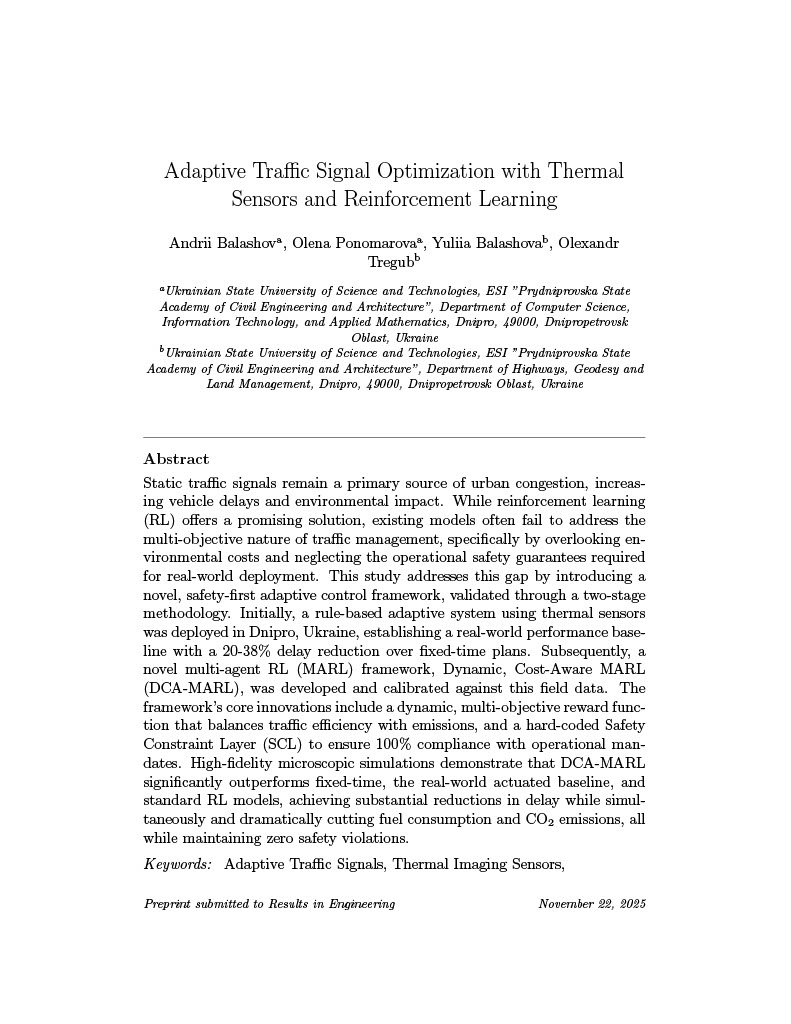
Illustration for Optimal Control and Differential Geometry Approaches to Designing Vertical Curves in Highways Using Artificial Intelligence Techniques

Optimal Control and Differential Geometry Approaches to Designing Vertical Curves in Highways Using Artificial Intelligence Techniques

Yuliia Balashova, Andrii Balashov

Scientific World Journal, 2024

  • The mathematical model shows that highway vertical curves can be optimized far more precisely when they are treated as an optimal control problem. This formulation captures the balance between earthwork cost, ride comfort, and safety in a way that traditional parabolic designs cannot.
  • Integrating artificial intelligence into the workflow further enhances performance. A neural network trained to approximate the optimal control reduced computation time by roughly half while maintaining accuracy.